Introduction
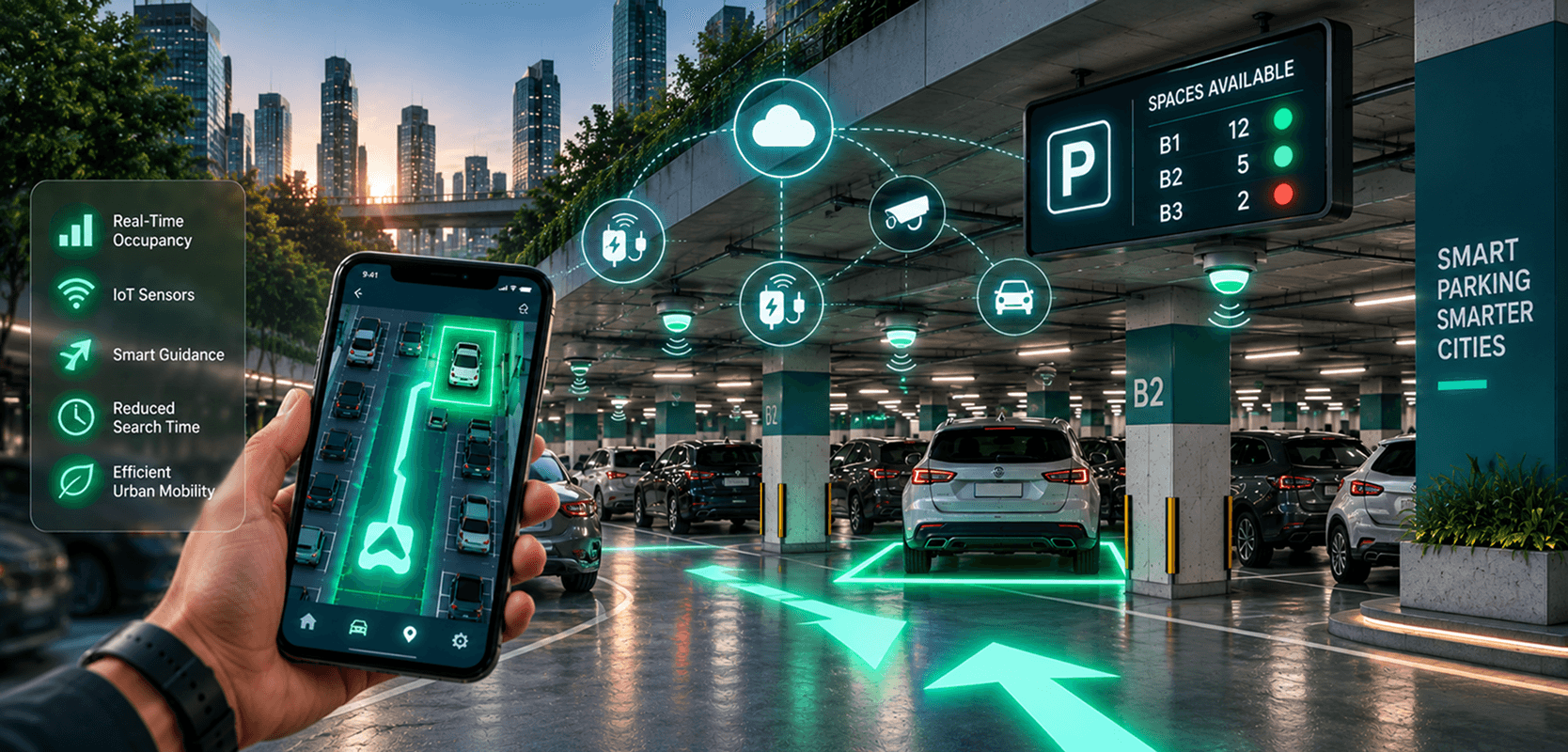
Parking is changing from a largely physical activity into an increasingly connected digital experience. Smart parking is the use of connected software, spatial data, sensors or vision systems, digital maps, mobile experiences and operational analytics to make parking easier to discover, navigate, use and manage. For organizations managing busy parking environments, the challenge is no longer limited to providing spaces. It is also about helping people discover the right facility, reach the right location, complete transactions efficiently, and move from the vehicle to the final destination with less uncertainty.
This shift is particularly relevant as shopping malls, airports, hospitals, hotels, residential communities, universities, corporate campuses and smart-city environments become larger and more digitally connected. A parking platform can become a bridge between physical infrastructure and the digital journey, bringing together location, availability, navigation, services and operational intelligence.
Traditional Parking: A Familiar but Fragmented Model
Traditional facilities often rely on physical signs, tickets, attendants, barriers and manual payment. These components can still be effective, but they do not automatically create a shared digital view of parking capacity or user movement.
Smart Parking: A Connected Model
Smart parking connects physical parking assets to software. Occupancy, access, reservations, maps, payments and analytics can be made available through a connected platform, creating an information layer around the facility.
The Difference Is Information Flow
The most important difference is not simply whether a facility has sensors. It is whether useful information can move between infrastructure, operators and drivers at the right time.
Choosing the Right Transformation
Not every facility needs the same architecture. Some may begin with digital payments and availability, while others may require indoor navigation, reservations, EV charging and analytics.
What Comes Next
The next stage is integration: parking becomes connected with navigation, charging, property technology, fleet services and wider mobility platforms.
Why It Matters
For drivers, the objective is a shorter and clearer journey from arrival to parking and back to the destination. For operators, the objective is better visibility, smoother operations, improved asset utilization and a digital platform that can support additional services. A connected parking experience can improve more than convenience. It can help organizations understand how their facilities are being used, identify operational bottlenecks, connect services, and create a foundation for future mobility integrations. The most meaningful transformation comes from solving a clearly defined user or operational problem rather than introducing technology simply because it is available.
There is also an important distinction between digitizing a parking facility and making it intelligent. Digitization can put information online; intelligence connects information to context and action. Availability can influence navigation, location can influence guidance, and operational data can influence planning. This is where a software-first parking platform can create value across the complete journey.
The OBPARK Approach
OBPARK is designed around the idea that a parking facility can become an intelligent digital ecosystem. The platform combines spatial computing, AI-oriented parking intelligence, digital mapping, indoor navigation, occupancy information, vehicle location, booking and analytics into a connected experience. OBPARK's current website positions the platform around GPS-free indoor navigation, AI parking intelligence, vehicle locator, digital-twin mapping, smart parking navigation and real-time occupancy. turn0view1
The platform is intended for environments including shopping malls, airports, hospitals, commercial buildings, residential communities, smart-city environments, universities, hotels, IT campuses and stadiums. The exact technology configuration can be adapted to the physical environment, existing systems, operational requirements and desired user journey. turn0view1
The Future of Connected Parking
Parking is moving toward connected mobility. As AI, spatial computing, EV charging, digital twins and mobility APIs mature, parking can become a software-defined layer of the built environment rather than an isolated facility. The direction is not simply toward more hardware or more applications. It is toward a parking experience in which physical infrastructure, spatial data, digital services and mobility systems can communicate with each other. This can create a foundation for smarter facilities while allowing organizations to evolve their deployments over time.
The strongest future platforms will be designed for interoperability. Parking should be able to connect with EV charging, property systems, access control, digital payments, navigation, fleet services and other mobility applications. This creates a broader role for parking: not merely a destination for a vehicle, but a digital mobility node within the built environment.
Make Parking More Intelligent with OBPARK
OBPARK is built to help organizations move from conventional parking management toward connected parking and indoor mobility. Whether the requirement is parking navigation, digital mapping, occupancy intelligence, vehicle location, booking, analytics or a larger connected mobility experience, the objective is to make the physical parking environment easier to understand and operate.
Explore OBPARK and discover how intelligent parking can become part of the next generation of connected mobility.
Talk to the OBPARK team to discuss a parking facility, enterprise deployment, technology integration or pilot.